On Friday, EFF and the law firm of Fish and Richardson filed an emergency motion to quash [pdf] and for the return of seized property on behalf of a Boston College computer science student whose computers, cell phone, and other property were seized as part of an investigation into who sent an e-mail to a school mailing list identifying another student as gay. The problem? Not only is there no indication that any crime was committed, the investigating officer argued that the computer expertise of the student itself supported a finding of probable cause to seize the student's property.
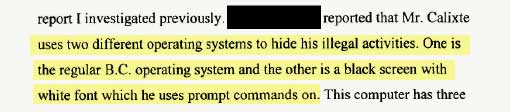
The warrant application [pdf] cites the following allegedly suspicious behavior:


Should Boston College Linux users be looking over their shoulders?
In his application, the investigating officer asked that he be permitted to seize the student's computers and other personal effects because they might yield evidence of the crimes of "Obtaining computer services by Fraud or Misrepresentation" and "Unauthorized access to a computer system." Aside from the remarkable overreach by campus and state police in trying to paint a student as suspicious in part because he can navigate a non-Windows computer environment, nothing cited in the warrant application could possibly constitute the cited criminal offenses. There are no assertions that a commercial (i.e. for pay) service was defrauded, a necessary element of any "Obtaining computer services by Fraud or Misrepresentation" allegation. Similarly, the investigating officer doesn't explain how sending an e-mail to a campus mailing list might constitute "unauthorized access to a computer system."
During its March 30th search, police seized (among other things) the computer science major's computers, storage drives, cell phone, iPod Touch, flash drives, digital camera, and Ubuntu Linux CD. None of these items have been returned. He has been suspended from his job pending the investigation. His personal documents and information are in the hands of the state police who continue to examine it without probable cause, searching for evidence to support unsupportable criminal allegations.
Next up? An emergency court hearing as soon as the court will hear us in which we will ask that the search warrant be voided and the student's property returned. Stay tuned...
Update I: A hearing on EFF's motion is scheduled for 11:00 a.m. ET on Tuesday, April 21, in Newton District Court.
Update II: Some commentators have disputed the conclusion that the student's use of an operating system other than the "regular B.C. operating system" was unfairly cited in the investigating officer's affidavit, arguing for example that the "use of Linux ... [is] simply evidence that connects Calixte to the emails at issue." With all due respect, I think that's missing the point.
To begin with, no "connection" is provided by the operating systems. Instead, according to the affidavit, (a) the student allegedly used a different operating system than the one used "regularly" at Boston College, and (b) the e-mails at issue were allegedly sent from a computer running Ubuntu Linux, also (apparently) "an uncommon operating system on the BC network." There is no indication of what the informant previously saw the student using: Ubuntu Linux, some other "flavor" of Linux, or even a terminal application on a Macintosh or Windows operating system. More to the point, however, the baseless assertion that a computer science major's use of "two different operating systems" must be "to hide his illegal activities" is absurd and was included as part of a laundry list of other unsupported accusations irrelevant to the alleged "crimes" for which the officer sought the warrant: sending e-mails to a Boston College mailing list. These claims do nothing to help establish probable cause that sending such e-mails could possibly constitute those crimes. As we argued in our brief, they can't. (An unsupported, contextless allegation of a separate incident of "hacking the grading system," for example, doesn't help the police meet their burden.) The unwarranted implication -- that because the student used an "uncommon" operating system and/or is technically sophisticated, he is more likely to be engaged in criminal activity -- should give one considerable pause.
Here are the relevant paragraphs in full:

Update III: On May 21, 2009, the Massachusetts Supreme Judicial Court granted Mr. Calixte's Motion to Quash and ordered that all searching of his property cease and that his property be returned immediately.