
Yesterday Aaron Swartz, a close friend and collaborator of ours, committed suicide. This is a tragic end to a brief and extraordinary life.
Aaron did more than almost anyone to make the Internet a thriving ecosystem for open knowledge, and to keep it that way. His contributions were numerous, and some of them were indispensable. When we asked him in late 2010 for help in stopping COICA, the predecessor to the SOPA and PIPA Internet blacklist bills, he founded an organization called Demand Progress, which mobilized over a million online activists and proved to be an invaluable ally in winning that campaign.

Other projects Aaron worked on included the RSS specifications, web.py, tor2web, the Open Library, and the Chrome port of HTTPS Everywhere. Aaron helped launch the Creative Commons. He was a former co-founder at Reddit, and a member of the team that made the site successful. His blog was often a delight.
Aaron's eloquent brilliance was mixed with a complicated introversion. He communicated on his own schedule and needed a lot of space to himself, which frustrated some of his collaborators. He was fascinated by the social world around him, but often found it torturous to deal with.
For a long time, Aaron was more comfortable reading books than talking to humans (he once told me something like, "even talking to very smart people is hard, but if I just sit down and read their books, I get their most considered and insightful thoughts condensed in a beautiful and efficient form. I can learn from books faster than I can from talking to the authors."). His passion for the written word, for open knowledge, and his flair for self-promotion, sometimes produced spectacular results, even before the events that proved to be his undoing.
In 2011, Aaron used the MIT campus network to download millions of journal articles from the JSTOR database, allegedly changing his laptop's IP and MAC addresses when necessary to get around blocks put in place by JSTOR and MIT and sneaking into a closet to get a faster connection to the MIT network. For this purported crime, Aaron was facing criminal charges with penalties up to thirty-five years in prison, most seriously for "unauthorized access" to computers under the Computer Fraud and Abuse Act.
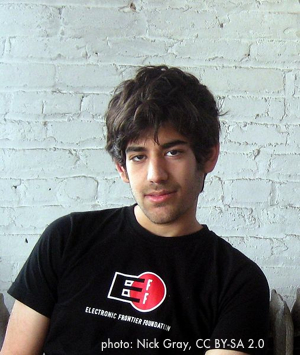
If we believe the prosecutor's allegations against him, Aaron had hoped to liberate the millions of scientific and scholarly articles he had downloaded from JSTOR, releasing them so that anyone could read them, or analyze them as a single giant dataset, something Aaron had done before. While his methods were provocative, the goal that Aaron died fighting for — freeing the publicly-funded scientific literature from a publishing system that makes it inaccessible to most of those who paid for it — is one that we should all support.
Moreover, the situation Aaron found himself in highlights the injustice of U.S. computer crime laws, and particularly their punishment regimes. Aaron's act was undoubtedly political activism, and taking such an act in the physical world would, at most, have a meant he faced light penalties akin to trespassing as part of a political protest. Because he used a computer, he instead faced long-term incarceration. This is a disparity that EFF has fought against for years. Yesterday, it had tragic consequences. Lawrence Lessig has called for this tragedy to be a basis for reform of computer crime laws, and the overzealous prosecutors who use them. We agree.
Aaron, we will sorely miss your friendship, and your help in building a better world. May you read in peace.
