Today, the Court of Appeals for the Eleventh Circuit issued an opinion blocking the use of copyright to censor unwanted online criticism. The decision, Katz v. Chevaldina, is important because although copyright law is frequently misused as a tool to censor speech, it rarely makes it into court to be challenged. And here, the court stopped the plaintiff in his tracks.
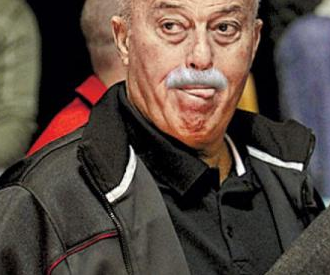
The "unflattering" Raanan Katz photo
As we explained in an earlier blog post, the plaintiff, Raanan Katz—the owner of a number of shopping centers throughout Florida and a minority owner of the Miami Heat—didn’t like how an online blogger was using an unflattering photograph of him in blog posts criticizing his business practices. So he acquired the copyright for the photograph and went after the blogger for copyright infringement. At the district court, the blogger, Irina Chevaldina, moved for summary judgment on the ground that her use of the photograph for the purpose of criticizing Katz was fair use and protected under federal copyright law. The district court agreed, ruling in favor of the blogger. But Katz appealed.
We filed an amicus brief with the Eleventh Circuit back in May, urging the court to see this behavior for what is was—i.e., a blatant attempt to abuse copyright law. The Eleventh Circuit agreed with us, seeing straight through Katz’ behavior and characterizing the case as “Katz’s attempt to utilize copyright as an instrument of censorship against unwanted criticism.” The court ultimately upheld the district court’s holding that Chevaldina’s use of the unflattering photograph was protected fair use.
In upholding the district court’s fair use holding, the Eleventh Circuit rejected Katz attempts to argue that Chevaldina was using the photograph for commercial use—an argument that we had pointed out to be ridiculous. As the court recognized, “Chevaldina unabashedly criticized and commented on the dealings of Katz, his businesses, and his lawyers. Chevaldina’s blog posts sought to warn and educate others about the alleged nefariousness of Katz, and she made no money from her use of the photo.”
The court also found that Chevaldina’s use of the photograph was transformative, “because, in the context of the blog post’s surrounding commentary, she used Katz’s purportedly ‘ugly’ and ‘compromising’ appearance to ridicule and satirize his character.”
The court further rejected the Katz’s disingenuous argument that Chevaldina’s use of the photograph would have a detrimental effect on the potential value of the photograph. As the court stated:
Katz took the highly unusual step of obtaining the copyright to the Photo and initiating this lawsuit specifically to prevent its publication. . . . Due to Katz’s attempt to utilize copyright as an instrument of censorship against unwanted criticism, there is no potential market for his work. (emphasis added)
In the meantime, back in May, the district court ordered Katz to pay Chevaldina $152,433.68 in attorneys’ fees plus another $2,403.50 in costs. The court admonished Katz, “During the more than two years that this litigation consumed, Plaintiff should have at all times known his claim would eventually fail when the truth of his motivations was eventually know.” The court went on:
[I]t is crystal clear that Plaintiff’s motivations pursuing this lawsuit were improper. Instead of using the law for its intended purposes of fostering ideas and expression, Plaintiff obtained the photograph’s copyright solely for the purpose of suppressing Defendant’s free speech. (emphasis added)
Katz’ attempt to use copyright to censor online criticism has only brought more (and more) attention to his abhorred photograph—a classic example of the Streisand effect. And we’re glad that both the Southern District of Florida and the Eleventh Circuit had the foresight to put a stop to such blatant abuse of the law.