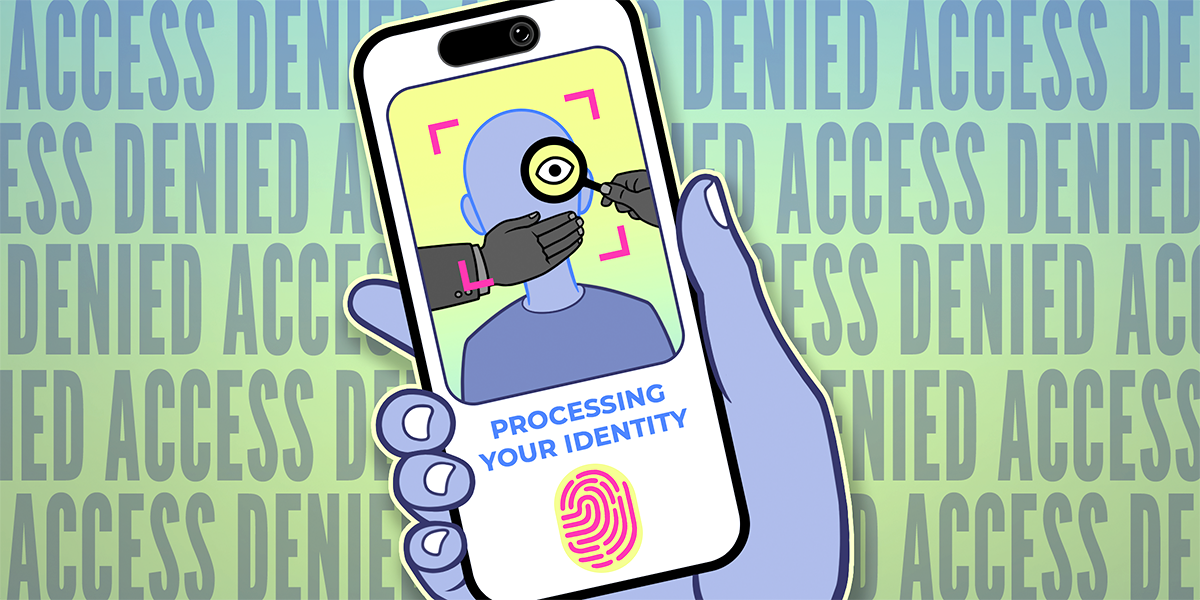
EFF opposes all mandatory age verification legislation because it enables government censorship and burdens access to online speech. Though age verification mandates are often touted as “online safety” measures for kids, the laws actually do more harm than good. They undermine the fundamental speech rights of adults and young people alike, create new barriers to internet access, and put at risk all internet users’ privacy, anonymity, and security.
So What Counts as an Age Verification Bill?
Age verification bills generally require online services to verify all users’ ages—often through invasive tools like ID checks, biometric scans, and other dubious “age estimation” methods—before granting them access to certain online content or services. Some state bills mandate the age verification explicitly, including Texas’s H.B. 1181, Florida’s H.B. 3, and Indiana’s S.B. 17. Other state bills claim not to require age verification, but still threaten platforms with liability for showing certain content or features to minor users. These bills—including Mississippi’s H.B. 1126, Ohio’s Parental Notification by Social Media Operators Act, and the federal Kids Online Safety Act—raise the question: how are platforms to know which users are minors without imposing age verification?
EFF’s answer: they can’t. We call these bills “implicit age verification mandates” because, though they might expressly deny requiring age verification, they still force platforms to either impose age verification measures or, worse, to censor whatever content or features deemed “harmful to minors” for all users—not just young people—in order to avoid liability.
No matter how they show up in legislation, age verification requirements are the wrong approach to protecting young people online. No one should have to hand over their most sensitive personal information or submit to invasive biometric surveillance just to access lawful online speech.