

UN Cybercrime Treaty Talks End Without Consensus on Scope And Deep Divides About Surveillance Powers
As the latest negotiating session on the proposed UN Cybercrime Treaty wrapped up in New York earlier this month, one thing was clear: with time running out to finalize the text, little progress and consensus was reached on crucial points, such as the treaty's overall scope of...

EFF to Michigan Court: Governments Shouldn’t Be Allowed to Use a Drone to Spy on You Without a Warrant

UN's Cybercrime Convention Draft: A Slippery Slope for LGBTQ+ and Gender Rights
This post is divided into two parts. Part I looks at the draft UN's Cybercrime Convention and its potential implications for LGBTQ+ rights. Part II provides a closer look at how cybercrime laws might specifically impact the LGBTQ+ community and activists in the Middle East and North Africa (MENA)...

Apple and Google Are Introducing New Ways to Defeat Cell Site Simulators, But Is it Enough?
Cell-site simulators (CSS)—also known as IMSI Catchers and Stingrays—are a tool that law enforcement and governments use to track the location of phones, intercept or disrupt communications, spy on foreign governments, or even install malware. Cell-site simulators are also used by criminals to send spam and engage...

Appeals Court Upholds Public.Resource.Org’s Right to Post Public Laws and Regulations Online
SAN FRANCISCO—Technical standards like fire and electrical codes developed by private organizations but incorporated into public law can be freely disseminated without any liability for copyright infringement, a federal appeals court ruled Tuesday. Tuesday’s ruling by a three-judge panel of the U.S. Court of Appeals for the District of...

Federal Judge Upholds State Department Rule Requiring Visa Applicants to Disclose Social Media Information
Since 2019, people applying for a visa to the United States have had to register their social media accounts with the U.S. government as part of the application process. Two U.S.-based documentary film organizations that regularly collaborate with non-U.S. filmmakers and other international partners sued the State Department shortly...
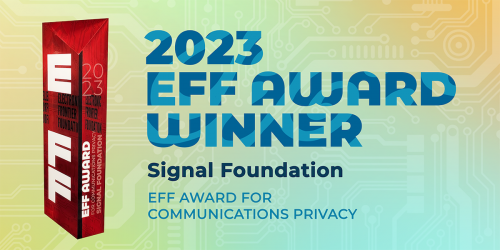
EFF Award Winner: Signal Foundation
In 1992 EFF presented our very first awards recognizing key leaders and organizations advancing innovation and championing digital rights. Now in 2023 we are continuing to celebrate the accomplishments of people working toward a better future for technology users with the EFF Awards!All are invited to attend the EFF...

Arkansas Lawmakers Could Wreck A 50-Year-Old FOIA Law This Week
Arkansas residents right now are facing a sudden and serious attempt to block their access to important government information. In a special session of the state legislature, announced Friday by Gov. Sarah Sanders and convened Monday morning, lawmakers are expected to discuss making major amendments to the Arkansas...

EFF Award Winner: Library Freedom Project
In 1992 EFF presented our very first awards recognizing key leaders and organizations advancing innovation and championing digital rights. Now in 2023 we are continuing to celebrate the accomplishments of people working toward a better future for technology users with the EFF Awards!All are invited to attend the EFF...
EFF Welcomes Erica Astrella and Yoshi Kohno to Its Board of Directors
SAN FRANCISCO—The Electronic Frontier Foundation (EFF) is honored to announce today that Erica Astrella, Head of Technology at Parkwood Entertainment and a leading voice for diversity and equity in tech, and University of Washington Computer Science & Engineering Professor Tadayoshi “Yoshi” Kohno, a renowned security researcher and scholar, have joined...

