


Argentinian Government Bans Civil Society Organizations From Attending Upcoming WTO Ministerial Meeting
The World Trade Organization (WTO), the multilateral global trade body that has almost all countries as members, has been eyeing an expansion of its work on digital trade for some time. Its current inability to address such issues is becoming an existential problem for the organization, as its relevance...

Internet Censorship Bills Wouldn’t Help Catch Sex Traffickers
SESTA and FOSTA Could Hide Trafficking from Law Enforcement
In the most illuminating part of last week’s House subcommittee hearing on the Allow States and Victims to Fight Online Sex Trafficking Act (FOSTA, H.R. 1865), Tennessee Bureau of Investigation special agent Russ Winkler explained how he uses...
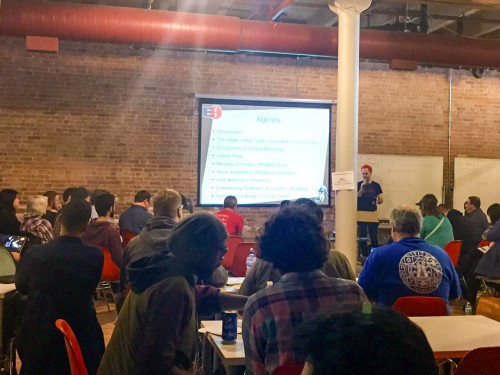
Community Groups Doubling Down on Defending Digital Rights
After the 2016 U.S. election, the prospects for digital rights under the incoming administration seemed particularly grim. A silver lining in this dark cloud has been the concerted efforts we’ve seen by groups working to defend digital rights at the local level. Over the past year, a growing network of...
New European Copyright Enforcement Plans Loom Large Even as Users Revolt Against Filter Proposal
EFF has joined over 80 groups in writing once again [PDF] to European politicians about disastrous new EU copyright proposals. Along with human and digital rights organizations, media freedom organizations, publishers, journalists, libraries, scientific and research institutions, educational institutions including universities, creator representatives, consumers, software developers, start-ups, technology businesses...
NAFTA's Digital Trade Chapter Could Be Finalized Next Month
The fifth round of negotiations over a modernized North American Free Trade Agreement (NAFTA) wound up last week in Mexico. Following conclusion of the round, Mexican Trade Minister Ildefonso Guajardo told reporters that he hoped that the next round, to be held in Washington, DC in the week of...

Proposed “Right to Know Act” Would Empower Users of Digital Devices to Decline NYPD Searches
New York City is considering a range of legislative measures to increase civilian control over the New York Police Department (NYPD). Earlier this year, EFF endorsed the proposed Public Oversight of Surveillance Technology (POST) Act to increase transparency into the NYPD’s acquisition of surveillance technology, such as license plate...

To Protect our Democracy, We Need to Protect Anonymous Low-Cost Online Political Speech
As Congress and the Federal Elections Commission explore ways to counter foreign influence in U.S. elections through greater campaign finance disclosures, EFF has filed comments reminding policy makers of the danger of going too far. While the FEC’s goals are understandable, it must take care not to undermine...
A Lump of Coal in the Internet’s Stocking: FCC Poised to Gut Net Neutrality Rules
In a new proposal issued last week, the Federal Communications Commission (FCC) set out a plan to eliminate net neutrality protections, ignoring the voices of millions of Internet users who weighed in to support those protections. The new rule would reclassify high-speed broadband as an “information service” rather...

DRM's Dead Canary: How We Just Lost the Web, What We Learned from It, and What We Need to Do Next
EFF has been fighting against DRM and the laws behind it for a decade and a half, intervening in the US Broadcast Flag, the UN Broadcasting Treaty, the European DVB CPCM standard, the W3C EME standard and many other skirmishes, battles and even wars over the...

EFF at Cyberspace Events in Delhi: Protecting the Public Core of the Internet
Last week EFF attended the Global Conference on Cyberspace (GCCS) in New Delhi, India, as one of a small handful of nonprofit organizations invited to participate. This was the fifth in a series of conferences sometimes called the London Process, after the first event that was held in London...

