
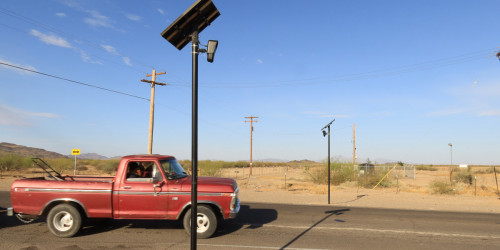
Flock Safety’s Feature Updates Cannot Make Automated License Plate Readers Safe
Today's Supreme Court Decision on Age Verification Tramples Free Speech and Undermines Privacy
Georgia Court Rules for Transparency over Private Police Foundation
A Georgia court has decided that private non-profit Atlanta Police Foundation (APF) must comply with public records requests under the Georgia Open Records Act for some of its functions on behalf of the Atlanta Police Department. This is a major win for transparency in the state. The ...

Two Courts Rule On Generative AI and Fair Use — One Gets It Right
Things are speeding up in generative AI legal cases, with two judicial opinions just out on an issue that will shape the future of generative AI: whether training gen-AI models on copyrighted works is fair use. One gets it spot on; the other, not so much, but fortunately in...
Ahead of Budapest Pride, EFF and 46 Organizations Call on European Commission to Defend Fundamental Rights in Hungary
This week, EFF joined EDRi and nearly 50 civil society organizations urging the European Commission’s President Ursula von der Leyen, Executive Vice President Henna Virkunnen, and Commissioners Michael McGrath and Hadja Lahbib to take immediate action and defend human rights in Hungary.The European Commission has a responsibility to protect...

How Cops Can Get Your Private Online Data

California’s Corporate Cover-Up Act Is a Privacy Nightmare
California lawmakers are pushing one of the most dangerous privacy rollbacks we’ve seen in years. S.B. 690, what we’re calling the Corporate Cover-Up Act, is a brazen attempt to let corporations spy on us in secret, gutting long-standing protections without a shred...

FBI Warning on IoT Devices: How to Tell If You Are Impacted
On June 5th, the FBI released a PSA titled “Home Internet Connected Devices Facilitate Criminal Activity.” This PSA largely references devices impacted by the latest generation of BADBOX malware (as named by HUMAN’s Satori Threat Intelligence and Research team) that EFF researchers ...

Why Are Hundreds of Data Brokers Not Registering with States?

Major Setback for Intermediary Liability in Brazil: Risks and Blind Spots
This is the third post of a series about internet intermediary liability in Brazil. Our first post gives an overview of Brazil's current internet intermediary liability regime, set out in a law known as "Marco Civil da Internet," the context of its approval in 2014, and the beginning...

