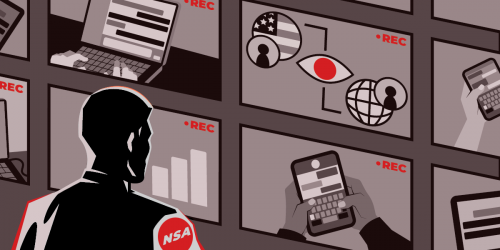

Why can the U.S. government collect my emails?
Under authority ostensibly granted by something called Section 702, the U.S. government routinely collects and searches the online communications of innocent Americans without a warrant through what are commonly called “upstream” and “PRISM” (now called “downstream”) surveillance—both are programs the National Security Agency uses the collect the information from companies that handle digital communications.
Section 702 is a surveillance authority passed as part of the FISA Amendments Act in 2008. That law amended the Foreign Intelligence Surveillance Act of 1978.
Section 702 is supposed to authorize collection of foreign intelligence from non-Americans located outside the United States. As the law is written, the intelligence community (IC) cannot use Section 702 programs to target Americans, who are protected by the Fourth Amendment’s prohibition on unreasonable searches and seizures. But as implemented, the law gives the intelligence community the ability to target foreign intelligence in ways that inherently and intentionally sweep in Americans’ communications.
We live in an increasingly globalized world where people are constantly in communication with people overseas. That means, while targeting foreigners outside the U.S. for “foreign intelligence
Information” the IC routinely acquires the American side of those communications without a probable cause warrant. The collection of all that data from U.S telecommunications and internet providers results in the “incidental” capture of conversations involving a huge number of people in the United States.
But this backdoor access to U.S. persons’ data isn’t “incidental.” Section 702 has become a routine part of the FBI’s law enforcement mission. In fact, the IC’s Annual Statistical Transparency Report documents the many ways the Federal Bureau of Investigation (FBI) uses Section 702 to spy on Americans without a warrant. The IC lobbied for Section 702 as a tool for national security outside the borders of the U.S., but it is apparent that the FBI uses it to conduct domestic, warrantless surveillance on Americans. Each year, the FBI conducts thousands or tens of thousands of warrantless searches of US persons’ 702 data, including intimate communications. And FBI is just one of the agencies that conducts these “backdoor searches.”
These problems are made more harmful and harder to understand and fix because of the cloak of secrecy which often hides when, how, and against who these programs are used.
In January 2025, a federal district ruled in United States v. Hasbajrami that backdoor searches of databases full of Americans’ private communications collected under Section 702 ordinarily require a warrant. Despite this ruling that unwarranted searches of this data are unconstitutional, the Intelligence Community continues to allow this sort of surveillance.
Currently, Congress has to renew Section 702 every few years. It was last renewed in 2024 and is set to expire in June of this year.
As the misuse of Section 702 for warrantless access to Americans’ communications demonstrate, national security laws that mandate secrecy and deference to the executive branch stand in the way of oversight by Congress, the courts, and the public.
Congress should overhaul the classification system and amend FISA to explicitly reject statutory interpretations by the Supreme Court that bar private litigants from enforcing their rights against unconstitutional surveillance.
 Protect digital privacy and free expression. EFF's public interest legal work, activism, and software development preserve fundamental rights.