
 EFFector Volume 38, Issue 17📱 Hey Siri, How Do I Limit AI Data Access?Welcome to an all-new EFFector, your regular digest on everything digital rights from the Electronic Frontier Foundation. In our 852nd issue: Drones and our right to record the law enforcement, video doorbell footage privacy, and how to limit what data Apple's new Siri AI can access. |
|---|
|
When you lose your rights online, you lose them in real life. Become an EFF member today! |
|---|
Featured Story: How to Limit What Apple’s New Siri AI Can Access in iOS 27
Apple’s new operating system is here, and along with it comes a new version of Siri, dubbed with two very familiar letters: AI. As the name suggests, this Siri power-up resembles an AI chatbot more than the often derided voice assistant you might be used to. It has even evolved from a blob you invoke with a verbal command or a button press to a whole app. This update comes with a slew of privacy complications, but you can take some control over what this new Siri can access and use. There’s no denying that the new version of Siri is far more powerful than it used to be, and arguably more useful at surfacing details on your phone. But that comes at the cost of deeper access. Once enabled, Siri and Spotlight are combined, unifying the interface. Where you may have once just pulled down on the screen to search for an app or contact, you’re now also invoking Siri. Note: Only iPhone 15 Pro/Pro Max, as well as all models of the iPhone 16 and newer support Apple’s AI features. Siri AI is currently only available in English, and not available worldwide. By default, ask Siri a question and it’ll search through your Apple apps, like Notes, Messages, emails, and more. As time goes on, if the developer chooses to let it, Siri will gain access to more and more third-party apps. Sometimes Siri processes this data on your device. Sometimes it uses Apple’s Private Cloud Compute (PCC), which means the data is sent off your device to a cloud server. In practice, ask Siri AI a question and you’ll never really know if it’s being computed on device or off. Apple claims what’s sent to PCC is not stored by the company after it is processed, but there are certain types of data or certain apps you might have on your phone that are not worth the risk. That’s especially true if you’re using a feature like Advanced Data Protection, which turns on end-to-end encryption for much of what’s stored in iCloud. Sending data that’s stored with end-to-end encryption off your device and into the cloud—no matter the privacy promises—is a fundamental change to the risk assessment you should make. This leaves the privacy of certain apps up to a strange combination of an app developer’s choices and your own. You can, of course, disable Siri entirely (Settings > Siri > "Turn Off Siri"), or choose not to invoke Siri to ask questions, but perhaps you don’t want to fully disable or disengage with the system. Thankfully, you can put some guardrails on Siri AI’s access. Once you’ve updated to iOS 27, read our guide to learn how to restrict Siri’s access to the content inside apps, revoke access to training data, and more.
EFF Updates👁 WATCHING THE WATCHMEN: Earlier this year, the FAA issued a flight restriction for drones that effectively criminalized the recording of Department of Homeland Security officers (including ICE) and their vehicles. While this restriction was later rescinded, an important case is challenging the ability of the government to punish drone pilots who record law enforcement officers engaged in official business. This month, EFF joined an amicus brief in support of the lawsuit's petitioner, urging the D.C. Circuit to vacate the FAA drone flight restriction that violated the First Amendment right to record law enforcement. 🔔 DOORBELL PRIVACY: Amazon recently debuted a new feature for its Ring cameras that the company is calling Throw Away the Key Encryption (TAKE). The idea is to cut back on the amount of video content available to the company, and thus potentially available to law enforcement. But while it might technically add a speed bump to accessing full video content, it doesn’t deliver nearly the level of privacy we should be demanding from video doorbells and other security cameras. Ring already offers the option for end-to-end encryption, and turning that on by default would offer the real sorts of privacy improvements we all want from video doorbells. 🤖 AI SECURITY BREACHES: Lawmakers are rightly concerned about reports concerning security breaches at major US AI labs. As with any technology regulation, policy targeting cybersecurity practices at AI labs must be careful, precise, and practical. Post-incident reports show that the Hugging Face incident could have been mitigated or prevented by following longstanding cybersecurity best practices, like stronger sandboxing and monitoring. Any new legislation should focus on closing gaps in existing law to prevent AI companies from taking unreasonable risks with the public's security. 🦸 PRIVACY'S DEFENDERS: The first episode of "Privacy’s Defenders" — our podcast about the people who’ve fought to secure your digital liberties since before most people even knew what the internet was — is now live! This time, Cindy Cohn is talking with John Gilmore about co-founding the EFF. It’s a story of the Secret Service’s “Operation Sundevil,” jet-setting tech titans, tie-dyed cypherpunks, and a fateful house party in San Francisco’s Haight-Ashbury district amid the earliest days of online communications. |
|---|
Support the Electronic Frontier Foundation
We're making sure technology serves all people—not just the powerful. Your contribution funds the attorneys, activists, and technologists who defend privacy, free expression, and human rights online—for everyone. Since 1990, EFF has led the charge for your digital rights. We're powered by members, and we need you in this fight. |
|---|
News QuizThink you've stayed on top of this week's news? Two of the following headlines are real. One is a fake. Which one is it?
Find out on the latest episode of the EFFector podcast. Listen here: 
MiniLinks🗣️ Free Speech 🔒 Privacy
💡 Creativity and Innovation 🔍 Transparency
AnnouncementsEFF Events
Corporate Giving and Sponsorships
|
|---|
Fresh EFF Gear Is Here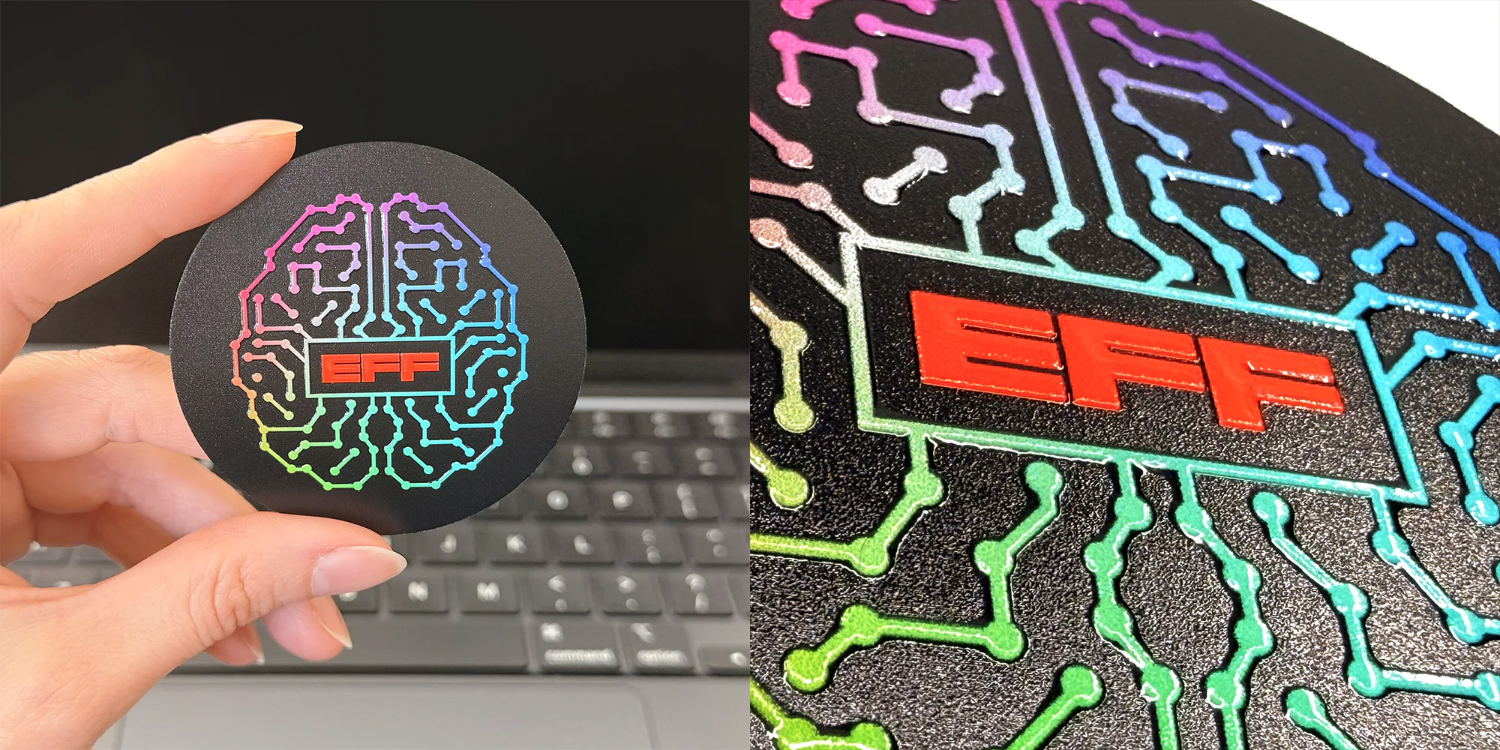
Show off your support for EFF with hot digital rights merch from our online store. Just in: an EFF circuit-board brain sticker with a textured finish that's as distinctive to touch as it is to look at. In addition to EFF shirts and hoodies, we have a wide variety of freedom-supporting swag in stock, including (extremely popular) liquid core gaming dice, HTTP playing cards, and a tactile Lady Justice braille sticker. |
|---|

AdministriviaEFFector is a publication of the Electronic Frontier Foundation. Editor: editor@eff.org Membership and donation queries: membership@eff.org General EFF, legal, policy, or online resources queries: info@eff.org
Reproduction of this publication in electronic media is encouraged. MiniLinks do not necessarily represent the views of EFF.
About EFFThe Electronic Frontier Foundation is the leading nonprofit defending online civil liberties. We promote digital innovation, defend free speech, fight illegal surveillance, and protect rights and freedoms for all as our use of technology grows. Find out more at https://www.eff.org/.
This message is printed from 100% recycled electrons. EFF appreciates your support and respects your privacy.
|
|---|
